Unpermitted Garage Conversion
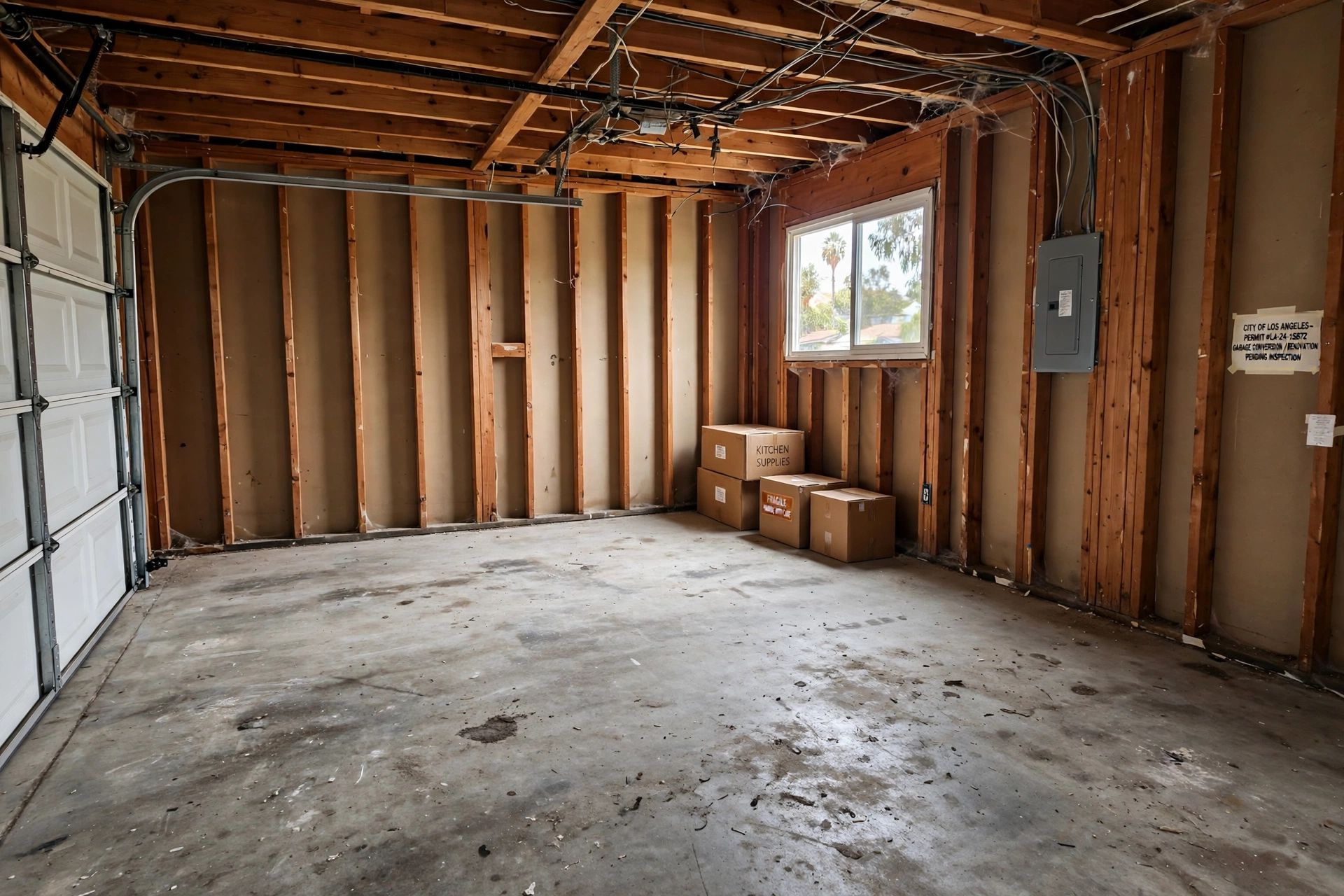
Los Angeles has thousands of garages that were turned into rooms without a permit. Some were converted decades ago by a previous owner. Some were done by a homeowner who did not know a permit was needed. Some were done knowingly, to save time and money. Whatever the history, the result is the same: a room that is not legal living space, and a problem that usually surfaces when the home is sold, refinanced, or inspected.
The good news is that legalization is often possible. Los Angeles County and the City of Pasadena have run amnesty programs for unpermitted work, and California state law has a path for conversions built before 2020. None of these programs is automatic, and none of them is a guarantee. Each case depends on what was built, when it was built, and whether it can be brought up to code.
This post is general information, not legal advice. The rules, the programs, and the fees change over time, and the right path for your garage depends on your city and your specific situation. Confirm the current options with the city building department or with a permit expediter before you act. For the full permit process, see our garage conversion permits page.
What 'unpermitted' means
An unpermitted conversion is a garage that was turned into living space without the required permit and inspections. There is no record with the city that the work was reviewed or approved. The room may look finished and may even be well built, but as far as the city is concerned, the garage is still a garage.
That distinction has real consequences. The room does not count as legal living space in an appraisal, so it does not add the value a permitted room would. A home inspector will flag it during a sale, and buyers often demand a price reduction or walk away. Insurance may not cover damage in the space. And if the city discovers the work, it can issue fines and require the walls to be opened for inspection, or in the worst case, the conversion to be removed.
Unpermitted does not always mean badly built. Many of these conversions are structurally sound and have served families for years. The problem is the missing paper trail: nobody has verified the wiring, the plumbing, the egress, or the structure. Legalization is the process of creating that paper trail after the fact.
The amnesty programs (LA County + Pasadena)
Amnesty programs are time-limited offers from a city or county to let homeowners legalize unpermitted work with reduced fees or a simplified process. Los Angeles County has run such a program for unpermitted dwellings, and the City of Pasadena has had an amnesty program for unpermitted builds, including garage conversions. These programs are designed to bring hidden housing into the legal system rather than punish the homeowners who report it.
The details matter and they change. A program may cover only work built before a certain date, only certain types of units, or only properties in certain areas. Fees may be reduced but are rarely waived entirely. And a program can close, which is why timing matters: a path that is open today may not be open next year.
If you think an amnesty program might apply to your garage, the first step is to ask. Call or visit your city's building department, or talk to a permit expediter who handles legalizations in your city. They can tell you whether a program is currently open, whether your property qualifies, and what the application involves. Do not assume a program you read about online is still running.
AB 2533: the pre-2020 path
California law provides a separate path for unpermitted units built before 2020. Under AB 2533, a local government generally cannot deny a permit to legalize an unpermitted accessory dwelling unit built before January 1, 2020 solely because the unit was built without a permit, as long as the unit can be brought into compliance with health and safety standards.
In practice, that means the city looks at whether the space is safe, not at whether the original builder had a permit. The inspector will check the structure, the electrical, the plumbing, the egress, and the ceiling height. Work that meets the safety standards can be approved. Work that does not must be corrected, and some corrections can be expensive, especially if wiring or plumbing is hidden behind finished walls.
This is a general description of the law, not advice about your specific case. The exact requirements, the deadlines, and the way your city applies the law can vary. A permit expediter or the building department can confirm whether this path applies to your garage and what it would involve.
What inspectors look for
When a city inspects an unpermitted conversion, it looks at the same things it would check in a new conversion, starting with life safety. Is there an egress window or door large enough for emergency escape? Is the ceiling high enough for living space? Is the electrical wiring safe, with a panel that can handle the load and circuits that are properly protected?
Next comes structure and health. Is the slab sound and dry, or is there moisture coming up through the floor? Are the walls framed and insulated? Is there ventilation, and is there heating? If there is a bathroom or a kitchen, is the plumbing properly connected, with real drains and venting? An inspector may ask for walls to be opened so the framing and wiring can be seen, especially if there is no record of how the work was done.
The inspection is not a pass-or-fail test on the first visit. It usually produces a list of corrections. Some are simple, like adding a smoke detector or a vent. Some are bigger, like replacing wiring or adding an egress window. The corrections list is what tells you whether legalization is a small project or a large one.
What legalization costs
Legalization costs vary widely, because they depend on what the inspector finds. A well-built conversion that mostly needs paperwork, plans, and a few corrections can be a modest project. A conversion with unsafe wiring, no egress, or a failing slab can cost nearly as much as a new conversion, because the work has to be opened up and redone.
The costs fall into three buckets. First, the administrative costs: plans that describe the existing work, the permit application, and the city fees. Second, the corrections: whatever the inspector requires to bring the space up to code. Third, the professional help: a designer to draw the plans and, in many cases, a permit expediter to guide the application through the city. There is no single price for legalization, and anyone who quotes one without seeing the garage is guessing.
Compare the cost of legalization against the cost of the alternatives. Leaving the conversion unpermitted costs nothing today, but it discounts the home at sale time and carries the risk of fines. Removing the conversion and restoring the garage also costs money and loses the room entirely. For many homeowners, legalization is the middle path that keeps the room and removes the risk.
Selling a home with an unpermitted conversion
An unpermitted conversion is a disclosure issue when you sell. In California, sellers must disclose known unpermitted work, and a buyer who discovers it after closing can come back with a claim. Most buyers will find it anyway: their inspector will note that the room does not match the city's records, and their lender's appraiser will not count it as living space.
That does not mean the home cannot be sold. Many homes with unpermitted conversions do sell, usually at a discount that reflects the risk and the cost of fixing it. Some sellers legalize before listing, which removes the issue and lets the room count in the price. Some sell as-is and let the buyer handle it. Which is better depends on your timeline, your budget, and your market.
If you are planning to sell within a year or two, get an honest assessment of the conversion before you list. Knowing what legalization would cost, and whether an amnesty program is open, gives you and your agent real numbers to work with instead of a surprise during escrow.
Get a free estimate
Reading is a good start — a site visit is better. Tell us about your garage and we will price the real scope, walk you through the permit path, and give you a fixed number. Free, no obligation.
Related service: Garage Conversion Permits
Request a Free Estimate
Tell us about your garage — we reply within one business day.